Hi, my name is
Vishwak Thatikonda.
I design large-scale systems for retail, fintech, and mobility.
Large-scale systems architect and full-stack engineer with 12 years of experience. Currently consulting through SDH Systems on enterprise master data, event-driven serverless infrastructure, and operational intelligence.

01.About
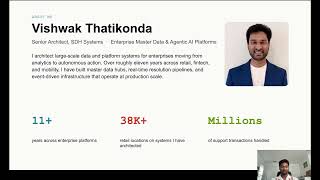
I build the data and workflow infrastructure that large enterprises run on. Over the past 12 years I have architected master data platforms, event-driven serverless systems, and omnichannel contact center software across retail, fintech, mobility, and geospatial SaaS. I currently consult through SDH Systems, leading architecture and full-stack work on enterprise platforms.
Most of that work sits where operational data has to stay correct at scale. Assortment models and store attributes that thousands of retail locations read as their source of truth. The hard part is rarely the algorithm. It is the seams between systems, and what happens to them under load and over years.
I've previously led engineering at Kyte, Credit Sesame, and Airworks. Earlier, at Arizona State University, I wrote software for the Mastcam-Z science payload aboard the Perseverance Mars rover alongside the team at NASA JPL. I contribute regularly to open source, with merged work in TensorFlow, the AWS CDK, AWS Lambda Powertools, and GraphiQL.
Currently
Enterprise master data architecture, event-driven serverless platforms on AWS, and making operational data usable by AI systems.
Education
- Master of Science, Computer Science
- Arizona State University, 2016 to 2018
- Bachelor of Technology, Computer Science
- Amrita University, India, 2011 to 2015


Certification
AWS Certified Solutions Architect Associate, 2020
02.Experience
2023 to present

Full-Stack Developer and Systems Architect at SDH Systems
Architecture and full-stack lead on enterprise platform engineering. Delivered the master data core that thousands of retail locations read as their source of truth, covering the assortment model, dynamic store attributes, and the sellable item metadata that downstream ordering, pricing, and personalization systems consume. Designed the cascade delete and override controls that closed off a class of silent corruption across product hierarchies. Contributed to an omnichannel contact center platform handling roughly 10 million calls a year, and to payments infrastructure operating at Fortune 1 retail scale with millions of transactions a day.
2026 to present
Technical Mentor at Arizona State University, Ira A. Fulton Schools of Engineering
Mentoring a four-student senior capstone team (CSE 485/486) building MenuIQ, a menu pricing intelligence tool for independent restaurants.
2022 to 2023

Lead Full Stack Developer at Kyte
Led the domain migration that lifted organic traffic 13x overnight and cut marketing spend with it. Shipped a guest checkout that raised monthly bookings 33%, and a template driven integration path that took online travel agency onboarding from three months to two weeks, an 85% reduction in engineering effort. Introduced the content management system that let the team publish two SEO pages a day without engineering involvement, lifting site traffic 12%.
2021 to 2022

Senior Full-Stack Developer at Credit Sesame
Set technical direction for the banking team and led the UI revamp across mobile and web. Drove the white labeling effort that took the credit building platform to multiple financial institutions under PCI compliance, and shipped rent payment reporting into members' credit utilization.
2019 to 2021

Full-Stack Developer at Airworks Solutions
First engineer on the web application team, joining at pre-seed and building the product through the company's Series A. Owned it from architecture through maintenance: the AWS platform from scratch, Stripe for payments, subscriptions, and billing, and the geospatial data layer behind the map product. Built the error reporting pipeline that cut both time to resolution and time to detection across the image processing stack.
2018 to 2019

Full-Stack Developer at Augmate Corp
Built the API behind an IoT wearable environment manager and the dashboards clients used to track connected devices across their warehouses. Piloted an asset tracking application for UPS on Hyperledger Fabric.
2016 to 2018
Software Developer at Arizona State University, School of Earth and Space Exploration
Developed the Mastcam-Z science payload software component aboard the Perseverance Mars rover in conjunction with the team at NASA JPL. Built the microservices carrying scientific data to and from the Martian rovers, and extended the tooling scientists use to run operations and transformations on returned imagery.
03.Speaking
February 2027
DeveloperWeek 2027Upcoming
Rebuild or Refactor: An Architect's Guide for Rebuilding Systems for the Agent Era
November 11, 2026
ASU Capstone Seminar
Designing for Scale Across Industries: Lessons from Retail, Fintech, and Mobility
October 28, 2026
ASU Capstone Seminar
From Student Project to Staff Engineer: The Skills the Classroom Skips
October 21, 2026
ASU Capstone Seminar
Building Systems That Survive Failure: Durable Workflows on Serverless
September 25, 2026
WeAreDevelopers World Congress North America
The $0.15/month Algo-Trader
Watch on YouTube: WeAreDevelopers World Congress North AmericaEvent page: WeAreDevelopers World Congress North America
September 24, 2026
Conf42 AI Agents 2026
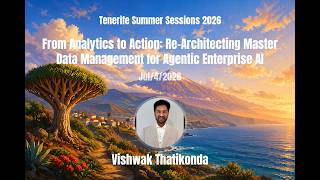
From Analytics to Action: Re-Architecting MDM for Agentic Enterprise AI
September 10, 2026
ASU Capstone Seminar
From Capstone to Production: How Enterprise Data Platforms Actually Work
July 15, 2026
AI in the New Era
July 4, 2026
Tenerife Summer Sessions


04.Research
Published
2026 · Journal article
Vishwak Thatikonda, Shravani Parsi
Software: Practice and Experience
Wiley
2026 · Journal article
Artificial Intelligence and Financial Performance: Examining Its Impact on Modern Businesses
M Deebika, Vanshika V Ahuja, Priyanka Tanwar, Vishwak Thatikonda, Jayant Isaac
International Journal of Artificial Intelligence and Machine Learning
SvedbergOpen · Vol. 6, Issue 13s, pp. 693–708
Accepted, proceedings pending
2026 · Conference paper
From Regulation to Runtime: Measuring the Machine-Verifiability of AI Governance Obligations
Harpreet S Siddhu, Nitin Garg, Vishwak Thatikonda
2nd International Conference on Emerging Trends in Engineering and Computing (ETECOM 2026)
Presented Oct 26–27, 2026, ENSTA Paris, France (hybrid)
Proceedings finalized for submission to IEEE Xplore (IEEE conference record #71863)
2026 · Conference paper
LambdaForge: An Empirical Evaluation of Cost, Tail Latency, and Reliability in Serverless Algorithmic Trading
Vishwak Thatikonda, Shravani Parsi
Presented Nov 18–19, 2026, University of Bahrain (hybrid)
Proceedings to be submitted to IEEE Xplore (2018–2025 editions in IEEE Xplore)
2026 · Conference paper
Durable Workflow Orchestration as a Library: Log-Native Sagas for Serverless Functions
Vishwak Thatikonda, Shravani Parsi
To be presented Nov 21, 2026, Jakarta, Indonesia
Proceedings to be submitted to IEEE Xplore (2025 edition in IEEE Xplore)
2026 · Conference paper
Garbage In, Confident Out: How Master-Data Defects Silently Degrade Multi-Step LLM Agents, and Which Data-Layer Controls Recover Them
Vishwak Thatikonda, Shravani Parsi
8th IEEE International Conference on Computer & Applications (IEEE-ICCA 2026)
To be presented Dec 21–24, 2026, Cairo, Egypt (hybrid)
Proceedings to be submitted to IEEE Xplore (2025 proceedings indexed in Scopus)
2027 · Conference paper
Trust Begins at the Record: An Agent-Ready Master Data Control Layer Evaluated Under Systematic Fault Injection
Vishwak Thatikonda, Shravani Parsi
IEEE International Conference on AI Engineering and Innovations (AIEI 2027)
To be presented Jan 21–23, 2027, Bangalore, India
Proceedings to be submitted to IEEE Xplore (2026 edition published by IEEE)
05.Projects and open source
LambdaForge
46 GitHub starsHands-off algorithmic stock trading that runs entirely on AWS Lambda for about fifteen cents a month. Python on AWS SAM, with the Alpaca API for execution.
Open source contributions
- merged pull requests
- 128
- projects
- 13
- combined GitHub stars
- 319k
Machine learning runtimes, cloud infrastructure tooling, and developer platforms.
All projects, by GitHub stars

tensorflow/tensorflow
Kernel hardening, XLA compilation, numerics · C++
201.7k GitHub stars64 mergedCrash hardening
- #123865
Unbatch aborted the whole process when given a malformed
batch_index. It now raises a catchable error, and a scalar index no longer produces a garbage error message. - #124050
A
ParallelConcatshape whose size overflows int64 crashed the process during graph optimization. The shape is now validated before the rewrite runs.(merged internally) - #125589
GradientTape.gradientsegfaulted when a composite target expanded to more tensors than theoutput_gradientssupplied. The counts are now compared and a mismatch raises a clear error. - #126021
A negative
num_elementsinBarrierTakeManyaborted the process. It is now rejected, matching the check the siblingDequeueManykernel already had. - #126028
The LSTM gradient kernels read out of bounds or aborted on mismatched input shapes. Every input's dimensions are now validated against the batch, cell, and time sizes.
- #126542
QR and SVD under XLA hit fatal checks for inputs of unknown rank. The kernels now validate rank and return an error.
- #123864
The crop-and-resize gradient kernels aborted on empty
boxesorbox_indextensors of the wrong rank, because an early return for empty inputs skipped validation. Ranks are now checked first. - #126161
SplitVaborted the process when itssize_splitstotal overflowed and wrapped back to a valid-looking size. Each split size is now checked before it is added to the total. - #126158
tf.raw_ops.Sliceaborted the process whenbegin + sizeoverflowed int64. The interval is now checked without overflowing and rejected with an error. - #129354
Scattering into a TensorList past its end filled the gaps with float tensors whatever the list's type, so reading a gap failed and stacking the list aborted the process. The gaps are now left unset.
- #128944
With oneDNN, the layout pass aborted the process when max pooling or quantized convolution attributes such as
strideswere outside the int32 range. Those attributes are now read as 64-bit integers.(merged internally) - #129359
Applying a mismatched gradient to a conditional accumulator, such as
float16into afloat32accumulator, logged the error and then aborted the process anyway. The kernels now stop after rejecting the input. - #129416
Summary kernels such as
ImportEventandWriteSummaryaborted the process when an input that must hold one element held zero or several. They now raise an error. - #128218
Finished the
SplitVoverflow work in shape inference, adding the rank checks and size bounds onsize_splitsthat the kernel already enforced.
XLA correctness
- #124874
map_fnunder XLA returned garbage when the mapped function changed the dtype. It now raises the same error eager and graph mode do. - #125167
take_along_axisfailed underjit_compilewhen a later op depended on its shape. The axis-swap branch is now resolved at trace time. - #126012
Integer
reduce_meanoverflowed under XLA and returned negative means for positive inputs. The accumulator is now widened to match eager results. - #126676
Slicing a dynamically shaped tensor (for example the output of
tf.where) under XLA silently dropped data, and on Linux corrupted the heap. The slice now carries the correct output size.(merged internally) - #126677
map_fnover an empty tensor failed to compile under XLA. Reads from a statically empty list are now allowed, since they never execute. - #127547
Writing past a
TensorArray's initial size under XLA silently truncated the result. It now emits a warning instead of failing quietly. - #128407
Under XLA,
tf.matmulwith an operand of unknown rank returned a wrong result for mismatched inner dimensions of size 1, such as[1, 4]times[1, 1], instead of raising. The XLABatchMatMulkernel now checks rank and inner dimensions like the non-XLA kernels.(merged internally) - #128040
XLA compiled both branches of an
Ifeven when its predicate was a compile-time constant, padding the result to a dynamic shape that later ops could not handle. This is whytf.image.rot90followed byfftshiftfailed underjit_compile. Only the taken branch is compiled now. - #128410
Under XLA,
tf.broadcast_totiled an input into any output size that was a multiple of it, so[1, 2]broadcast to[2, 6]returned repeated data instead of raising. The XLA kernel now enforces TensorFlow's broadcasting rule. - #128408
Segment reductions such as
unsorted_segment_sumwithnum_segments=0failed to compile under XLA instead of returning an empty result like eager does. The kernel now returns the empty result and rejects a negativenum_segments. - #129006
Under XLA, categorical sampling from large
bfloat16orfloat16logits was biased toward the first class, because the random noise was rounded away at that precision. Sampling now happens in float32. - #128997
Under XLA,
tf.rangewith a start or limit known only at runtime returned the wrong length or values, such as an empty result fortf.range(n - 1, -1, -1). The output size now accounts for negative steps. - #129057
Under XLA,
tf.linalg.set_diagon a matrix with a dimension known only at runtime failed to compile or dropped columns. It now works from the matrix's runtime size. - #129059
Under XLA,
tf.linalg.diag_partof a matrix with a dimension known only at runtime returned diagonals padded with entries from outside the matrix. Both XLA lowerings now use the runtime size. - #128982
Under XLA,
tf.reverse_sequencereturned a runtime-sized sequence dimension at its maximum size, padding the result with stale values. The output now keeps the runtime size. - #128629
tf.image.non_max_suppressionwithfloat16boxes failed to compile under XLA because its thresholds stayedfloat32. They are now converted to the boxes' type, as the TensorFlow kernels already did. - #128409
Under XLA, a
tf.slicewhose size was only known at runtime could set an output size larger than its buffer when that size ran past the input, corrupting the heap on Linux. The runtime size is now clamped to the buffer's bound. - #129322
Under XLA, an element-wise op between a static dimension and a longer runtime-sized one corrupted the heap. The runtime size is now capped at the static dimension's size.
- #128993
Under XLA,
tf.linalg.diagof a diagonal with a runtime length returned a matrix sized by that length's maximum. The output is now sized from the runtime length. - #129714
Under XLA on CPU,
tf.random.stateless_uniformandstateless_normalreturned different values from eager for the same seed, because seed handling, the bits-to-float conversion and the normal transform all differed from the TF kernels. XLA now matches them on CPU and GPU. - #129705
Under XLA, the gradient of
tf.where(x > 0, tf.sqrt(x), 0)was NaN atx <= 0, becauseSqrtGrad,RsqrtGradandReciprocalGradapplied their formula even when the upstream gradient was zero. They now return zero there, as the TF kernels do. - #129817
Under XLA, integer
tf.powwith a negative constant exponent returned 0 instead of raising, as the CPU and GPU kernels do. XLA now rejects it too.
Numerical correctness
- #123867
tf.experimental.numpy.iscloseignoredrtolandatolfor integer inputs. Tolerances are now applied, matching NumPy. - #126208
A graph optimizer rewrote
1/yinto a reciprocal op that is not exact on x86, so graph mode disagreed with eager. The rewrite is removed. - #127946
xlogy,xlog1py, andxdivyreturned-0instead of0on the vectorized CPU path. They now return+0, matching the documentation and the XLA kernels.(merged internally) - #128034
The GPU kernels for
xlogy,xlog1py, andxdivyhad the same-0problem in separate code. They now return0too, so CPU and GPU agree. - #129336
In eager, a Python float converted to
bfloat16lost its value when it was subnormal in bfloat16, while graph mode and NumPy kept it. Eager now converts directly tobfloat16. - #129621
reduce_varianceandreduce_stdturned rounding error in the mean into variance, so three float32 values of 1e10 gave a variance of 1,048,576 under XLA instead of 0. The formula now corrects for that error.
API validation and error messages
- #125269
tf.reverseaccepted out-of-range axes in eager mode for scalar and empty inputs, while graph mode rejected them. Both now reject them. - #125591
eigh_tridiagonalwithselect='i'or'v'and noselect_rangefailed with an opaqueTypeError. It now raises aValueErrornaming the missing argument. - #125594
bincountsilently returned a short result whenmaxlengthwas belowminlength. Contradictory bounds are now rejected. - #125799
Indexing a captured eager
TensorArraywith a symbolic tensor insidetf.functiongave misleading advice. It now raises an error that describes the actual problem. - #124760
DequantizeandQuantizeV2silently accepted anaxisbelow -1 in eager mode and treated it as per-tensor quantization. The kernels now reject it, as graph mode already did.
tf.function tracing
- #128161
tf.functionreused a trace for Python arguments that compare equal but behave differently, such as1,1.0, andTrue, or0.0and-0.0. Each now gets its own trace. - #128432
eigh_tridiagonalfailed with aTypeErrorinside atf.functionwhose input length is only known at runtime, because it did Python arithmetic on the static length. It now reads the length at runtime when it is not known statically.(merged internally) - #129060
tf.linalg.set_diagwith a band failed to trace when the input's dimensions weren't all known, although the same call ran in eager. Shape inference now handles the unknown dimensions. - #129616
Every
@tf.custom_gradientcall in graph mode registered its gradient function globally and never removed it, so each traced graph stayed in memory for the life of the process. The gradient function is now owned by its graph and released with it.
tf.data
- #129701
FixedLengthRecordDatasetsized its read buffer frombuffer_sizealone, so a huge value aborted the process even for an 80-byte file. Buffers are now capped at the file size. - #128120
sample_from_datasetshung forever whenweightswas a tensor with a zero entry, while the same weights as a list finished. Zero-weight datasets are now skipped.
Kernels and bindings
- #128996
On CPU with oneDNN, the default on x86,
tf.nn.softmaxfailed for inputs of rank 6 or more. Higher ranks now collapse onto the existing 2-D path. - #129139
The Go bindings leaked a copy of the session config every time
TF_SetConfigrejected it. The copy is now freed on both paths. - #128296
Conv2Dgradients and the oneDNNConv2Dkernel mishandled empty tensors. An empty input now yields an empty output or a zero gradient.
View on GitHubPackaging, logging, docs
- #127825
pip install tensorflow-cpufailed on Linux ARM64 and Apple silicon because the package was never published there. The existing ARM builds are now also published under thetensorflow-cpuname.(merged internally) - #125002
The GPU
CheckNumericskernel flooded stderr with a raw log line on every NaN or Inf, duplicating the error already returned. The log is now verbose-only. - #125697
Added a security note that
tf.io.gfiledoes not prevent path traversal or restrict symlinks, so callers must validate untrusted paths. - #123855
Updated the
Dataset.concatenatedocstring examples to show the error message TensorFlow actually raises. - #127661
Restored a word-scrambled Apache license header in a GPU kernel header.
- #127780
libtensorflow_frameworkexported LLVM's C API to every library loaded alongside it. It now exports only the target initializers TensorFlow calls, hiding 911 of the 912 exports in the 2.21 wheel. - #129063
libtensorflow_frameworkexported the functions of its bundled curl, which could stand in for the system's libcurl in the same process. They are now hidden, as the LLVM C API already was. - #129417
Disabling and re-enabling Debugger V2 with the same dump directory failed, and segfaulted on 2.21, because closed writers still counted as initialized. Re-enabling now reopens the files.
- #123865

keras-team/keras
Deep learning API for JAX, TensorFlow, and PyTorch · Python
64.4k GitHub stars4 mergedView on GitHubLayers
- #23687
Bidirectionalreported the wrong output shape when its backward layer had a different number of units from the forward layer, so models built on it failed to train. This had been broken since the Keras bundled with TF 2.15. - #23902
AttentionandAdditiveAttentionattended over masked values when every position in a row was masked, and float16 masking producedNaNgradients. Fully masked rows now attend to nothing, with zero output and gradients. - #23924
GroupNormalizationreturned 0 instead ofbetafor groups of large, identical values, because float32 rounding cancelled the offset. It now centers before scaling. - #23782
LayerNormalizationreturned 0 instead ofbetafor constant rows of large values, because float32 rounding cancelled the offset. It now centers before scaling, matching theGroupNormalizationfix.
- #23687

graphql/graphiql
GraphQL IDE and language server · TypeScript
16.9k GitHub stars5 mergedEditor and IDE
- #4329
The editor flagged valid SDL such as
type Bar @baz(no field block) as an error. - #4332
Image previews in the response pane fetched from the current site instead of the image's real host.
- #4557
Invalid JSON in the Variables or Headers pane now reports a plain message with line and column, and says the request was not sent.
View on GitHubLanguage server packaging
- #4329

aws/aws-cdk
Infrastructure as code for AWS · TypeScript
13k GitHub stars15 mergedIAM and permissions
- #37892
TableV2grants left out index ARNs when indexes were added after the table, so IAM denied queries against them. - #38154
Reusing one WebSocket Lambda integration across routes granted invoke permission to the first route only, so the others failed at runtime.
- #38365
TableV2MultiAccountReplicarejected imported tables with partly tokenized ARNs as "same account" when they were not.
Lambda bundling
Template validation
- #39132
CloudFormation validation grouped findings by rule only, so most resources were reported with another resource's message and values. Findings with different messages are now reported separately.
EC2
- #39168
Added the Graviton5
c9gcompute-optimized instance class, which resolves to ARM64 automatically.
View on GitHubBedrock models and docs
- #38760
Added the OpenAI foundation models on Bedrock to both model catalogues.
- #38927
Added the OpenAI GPT-6 family and GPT-6.1 Sol to both model catalogues.
- #38272
Added the Claude Sonnet 5 foundation model identifier.
- #38571
Added the Claude Opus 5, Fable 5, and Mythos 5 foundation models to both model catalogues, with capability flags taken from the Bedrock model cards.
- #38998
Added Claude Haiku 5.5 to both model catalogues, noting that it has no APAC cross-region inference profile.
- #38162
Documented that
RuleTargetInput.fromTextJSON-encodes its input, and why. - #38557
Added Claude Sonnet 5 to the alpha Bedrock module, which the main library already had.
- #39461
Documented that removing a VPC-mode AgentCore runtime can leave its security groups behind, because the service releases its network interfaces asynchronously.
- #37892
aws/aws-sam-cli
CLI for building and deploying serverless applications · Python
6.7k GitHub stars1 mergedView on GitHubTemplate handling
- #8987
sam deploy --guidedcrashed withTypeError: unhashable type: 'list'when aCommaDelimitedListparameter shared its name with a resource or output. Such templates now resolve.
- #8987

openxla/xla
Machine learning compiler for GPUs, CPUs, and TPUs · C++
4.7k GitHub stars1 mergedView on GitHubNumerical correctness
- #50611
RegularizedIncompleteBetareturned NaN whenaorbwas large but finite, because its continued fraction multiplied values that overflowed float32. Each term is now computed as a product of ratios.(merged internally)
- #50611

adaltas/node-csv
CSV parsing and generation for Node.js · JavaScript
4.3k GitHub stars2 mergedView on GitHubParsing and stringify

aws-powertools/powertools-lambda-python
Observability and utilities for AWS Lambda · Python
3.3k GitHub stars3 mergedTracer and metrics
View on GitHubEvent handler
- #8629
Fixed seven event handler bugs from one report, including AppSync context leaking into the next invocation, Bedrock Agent responses keyed under a
nullmedia type, and duplicateRouterroutes silently overwriting each other.
- #8629
aws-powertools/powertools-lambda-typescript
Observability and utilities for AWS Lambda · TypeScript
1.8k GitHub stars21 mergedConcurrency on Lambda Managed Instances
- #5444
Overlapping invocations closed each other's X-Ray subsegments in the Middy tracer middleware. Segments are now stored per request.
- #5543
One invocation starting to buffer logs wiped the buffered logs of every other in-flight invocation. The log buffer is now scoped per invocation.
- #5544
A debug-sampling decision in one invocation changed the log level for all concurrent invocations. The effective log level is now scoped per invocation.
- #5548
Consolidated the per-invocation log level into the existing invocation store, following maintainer review.
Logger and metrics
- #5227
critical()did not flush the log buffer the wayerror()does, so the most severe failures lost their debug context. Any level at or above ERROR now flushes. - #5228
setDefaultDimensions()ignored regular dimensions when checking CloudWatch's dimension limit, so metrics could be silently dropped. - #5229
Dimension limits are now enforced per dimension set, the way CloudWatch EMF counts them, instead of double-counting overlapping keys.
Event handler (HTTP)
- #5257
Single-value headers that contain commas, such as
DateandExpires, were split into multiple values on API Gateway v1 and ALB. Only known multi-value headers are split now. - #5267
Valid CORS preflight requests without
Access-Control-Request-Headerswere rejected. They are now accepted, per the Fetch standard. - #5310
The HTTP metrics middleware pulled the optional metrics package into every bundle, crashing functions at init when it was not installed. The runtime import is removed.
Parser event schemas
- #5749
The REST API event schema stripped the custom context returned by a Lambda authorizer, which is usually the reason to use one.
- #5777
The Cognito trigger schemas rejected events Cognito sends in common flows, so custom auth challenges and custom email and SMS senders could not be parsed at all. They now match events captured from a live user pool.
- #5773
VPC Lattice v2 sends every header and query string value as an array, but the schema expected plain strings, so no real v2 event could be parsed.
- #5772
The SES schema required fields SES only sends sometimes, such as
dmarcPolicy, so most receipt events failed to parse. It also read Reply-To under a key SES never sends. - #5666
Malformed base64 in Kinesis events made
safeParsethrow instead of returning a failure, and surfaced as an unhandled rejection throughparse(). - #5784
The parser docs listed six schema names that did not match the package's exports, so importing them as documented failed.
- #5846
SnsSqsEnvelope.safeParseturned errors thrown by the user's schema into a generic validation issue, hiding the original error. They now propagate, as in every other envelope. - #5839
The Kafka schema threw on header bytes of 128 or above, which Lambda sends as signed Java bytes, so real events with non-ASCII headers failed to parse. Headers now decode as UTF-8 from signed or unsigned bytes.
View on GitHubIdempotency and commons
- #5717
If a handler mutated its input, idempotency completion and cleanup targeted a different key, leaving the record stuck in progress. Record identity is now fixed when the operation starts.
- #5295
LRUCachewith a max size of 0 permanently kept one stale entry after eviction. - #5873
A durable Lambda execution suspended past its first invocation kept an in-progress expiry, so another execution with the same payload could take over its record and run twice. Durable executions now own their record by execution ARN and store no expiry.
- #5444

aws-amplify/amplify-ui
Authentication UI components · TypeScript
1.1k GitHub stars3 mergedAuthenticator
View on GitHubCI
- #7086
The issue-labeling workflow failed on every community comment on a pull request.
- #7086

hetznercloud/hcloud-cloud-controller-manager
Kubernetes cloud controller for Hetzner Cloud · Go
935 GitHub stars1 mergedView on GitHubHelm chart
- #1258
The Helm chart now ships non-root, read-only security defaults that pass the Pod Security
restrictedprofile.
- #1258
aws/graph-explorer
Visual explorer for graph databases · TypeScript
492 GitHub stars4 mergedView on GitHubQueries and engine compatibility
- #1800
The neighbor count query crashed on Neptune 1.3.x. It is rewritten to work on both 1.3 and 1.4 engines.
- #1769
SPARQL queries using the
?s ?p ?oshorthand now render their results as a graph. - #1856
Migrated class internals to runtime-enforced
#private fields. - #2069
Clearing the neighbor limit field stored
NaN, so expansions ran with no limit while the toggle still showed one. Expand is now disabled until a valid limit is entered.
- #1800

chaynHQ/bloom-frontend
Chayn's platform supporting survivors of abuse · TypeScript
72 GitHub stars3 mergedView on GitHubMaintenance
06.Contact
LinkedIn is the most reliable way to reach me. I am also on the networks below, and my resume is available as a PDF.